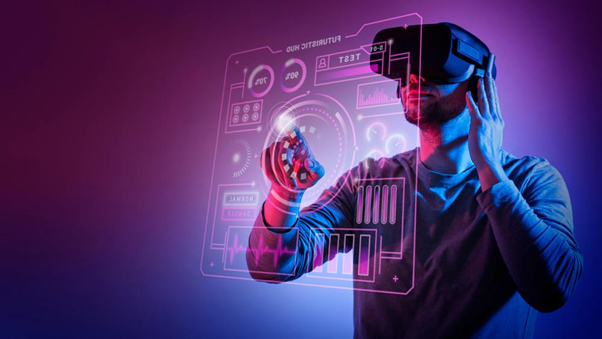
The “metaverse” is merely a hazy and superfluous idea for many instructors. And that makes sense. However, metaverse technologies are expanding swiftly and will have a significant impact on how people learn and teach in the future.
What exactly is a metaverse?
The metaverse can be thought of as a digital recreation of the real world. It consists of a variety of unrestricted, open, and decentralized games, social networks, and gathering places that exist within a network of linked computers. Anyone can participate in or build interactive digital environments in the metaverse. It represents a fundamental shift in how we communicate with one another and participate in virtual worlds.
How does it function?
The metaverse uses AI to construct immersive, 3D, real-time, and interactive social spaces. It also uses augmented reality, virtual reality, and “Web3” technology. Users of the metaverse can connect with each other, develop things (alone or in groups), play games, and engage with avatars and 3D digital objects in these settings.
Exists the m etaverse now?
There are gaps in the metaverse. Although there are virtual, interactive worlds that offer a “metaverse experience,” they are not connected and only offer a very small amount of social interaction. However, the underlying technologies of the metaverse are developing quickly, and many experts predict that the metaverse development company will become commonplace soon.
What examples of the metaverse are there?
Games like Roblox, Fortnite, and Minecraft are among its more well-known manifestations for many people. These “virtual worlds” are socially interactive online environments featuring avatars and 3D digital objects.
Blockchain, a secure “digital ledger” of transactions, and NFTs (non-fungible tokens), a sophisticated mechanism to reproduce physical objects as digital files, are examples of related technology. Web3, a plan for a redesigned and decentralized Web where users control their online behaviors, is also related. All told, these technologies aid in developing systems that enable people and organizations to own, purchase, share, or sell goods.
Is there now use of the metaverse in education?
Additionally, Eduverse, a web-based “safe and secure” K–12 metaverse experience for classrooms, was just unveiled Avantis Education. Students can explore Eduverse on their own or alongside classmates in a teacher-controlled setting while interacting as avatars in a virtual reality (VR) environment. Eduverse also provides access to instructional VR content and boasts the “first educational VR theme park.”
Additionally, educators can connect and learn about fundamental metaverse technologies through K20 Educators, a brand-new social learning network in the metaverse (also known as the “eduverse”). The network seeks to educate educators for the metaverse offering “meaningful & innovative professional learning experiences.”
Technologies underlying the metaverse have also been used in education for a while.
Virtual Reality (VR) is one illustration. VR makes it possible to design immersive learning experiences that can improve students’ comprehension of a subject. Users of VR headsets can immerse themselves in a variety of real-world or made-up situations. In Becoming Homeless: A Human Experience from the Stanford Virtual Human Interaction Lab, participants spend days in the life of a person who can no longer afford a home and interact with various environments in an effort to save the home. This learning experience is one example of this kind. According to Stanford researchers, the VR experience “changes helping behavior” and has an extended effect.
Augmented Reality (AR) is yet another underlying technology of the metaverse. With AR, one can “augment” a real-world situation superimposing images, movies, and sounds onto an already existing environment. (Unlike VR, where they are not entirely immersive and no goggles or headsets are needed.) A straightforward application of AR is to enhance course materials. For instance, on a textbook page depicting a World War II combat, photographs, films, and audio of the action could be overlay. In a similar vein, reading material on the functions of the heart might include photos, videos, and sounds of the human heart superimposed on them. AR can therefore help with the development of customized, multimedia instructional materials.
However, social interaction is lacking and there is no connectivity between VR and AR devices. They fall short of creating a true metaverse setting.
Artificial intelligence (AI) is a third associated metaverse technology that is transforming. Computers can now complete tasks that are frequently linked with human intellectual processes thanks to artificial intelligence. While computers are replacing humans in the workforce, artificial intelligence (AI) in education has largely been restricted to tutoring software that tries to make instructional materials more personalized for pupils. Knewton, an AI-powered platform that creates custom lesson plans for students, is one illustration. In schools and universities, these so-called “adaptive” or “personalized” AI-infused learning platforms are being employed more frequently. These, however, fall well short of the networked, virtual social interaction found in the metaverse.
Having said that, a “virtual human” educational universe is starting to take shape. The first “Artificial Human,” called Neon, was released in 2020 Star Labs, which was supported Samsung. Photo-realistic videobot Neon can move, talk, and grin “with such authenticity that it is impossible to tell they are computer-generated.” Neons are being advertised as educational tutors since they are able to learn information about their users and talk in any language.
Additionally, AI educators are starting to appear. For instance, the UK’s AV1 distance-learning robot enables youngsters with chronic illnesses to attend school. In place of the student, AV1 can raise its hand, speak aloud to the class, or converse quietly with peers. In China, Keeko, an autonomous robot that can narrate stories and pose riddles, has gained the support of 600 kindergarten students. Keeko reads aloud to children while asking them to make predictions, engages in educational activities, remembers discussions, and identifies people.
AI is having unexpected effects on language processing and writing that may surprise educators. GPT-3 is a brand-new AI tool that was just released. In order to produce stories, develop characters, offer sensory detail, design lyrical language, and other things, “Generative Pre-trained Transformer, Version 3” consumes and analyzes a huge amount of text from the Internet and other publications. GPT-3 just needs a short quantity of text from the user to produce “impressive” and “human-sounding” language. GPT-3 is one of many “enormous ethical and pedagogical AI challenges facing educators,” as I describe in this post.
In general, AI will support the metaverse developing digital humans that interact with real humans in the metaverse, such as 3D chatbots or videobots. AI will also aid users in language processing, enabling more natural Metaverse interaction. Teachers will have to decide how much they will be incorporated into teaching and learning.
What future effects will the metaverse have on education?
There are a lot of unknowns, but here are some possible outcomes.
In general, the metaverse will make it possible for lots of students to learn in wholly immersive, multimedia settings that combine the real and virtual worlds. For instance, in a geometry lesson, students might learn geometric equations viewing and interacting with geometric forms in a virtual reality environment while also listening to a math expert provide context and help. Students might also be working together virtually to solve geometrical puzzles with peers halfway around the world. To further comprehend how mathematical principles are used in real-world applications, students may be engaged digitally in an architect’s or engineer’s office looking at drawings of recently designed city skyscrapers. Students will sometimes work on different activities and at different paces while working both individually and collaboratively. The teacher will occasionally engage in a conversation with the class in a completely physical setting to assess their progress, spark a debate, and look for indications of thoughtful problem solving. All in all, a rich metaverse learning environment would combine the real and virtual worlds and make use of multimedia to offer students a variety of educational possibilities in a collaborative context.
Students will increasingly demand immersive, dynamic, and engaging online learning environments, which will lead to the emergence of metaverse programs (or “metaverse schools”) and a decentralization of learning. Students are no longer constrained the formal or spatial restrictions imposed school or university administration in a decentralized learning environment. Alternatives to traditional teacher-centered, pen-and-paper instruction in brick-and-mortar schools will be sought after students and their parents. There will be more immersive options, including the STEM metaverse for kids aged 6 to 14, which uses real-time, online multiplayer games to teach science concepts. Schools and universities may be better positioned to address issues connected to a lack of physical space, student disengagement, and teacher shortages providing students with interesting alternatives to traditional classroom instruction. There will, overall, be increasing difficulties for conventional pedagogy and programs as more varied and intense online learning experiences come into being.
Gamifying learning will increase. Games mechanics and game design components, like competition, points, and prizes, will increasingly be incorporated into virtual learning experiences. Users will be immersed in games and be taken beyond the confines of 2D game screens in fully immersive 3D VR and AR environments. Gamified aspects are anticipated to gain popularity among kids and teenagers as they become more immersive and interesting. The demand for gamified learning activities is anticipated to expand along with the need for augmented reality, virtual reality, and artificial intelligence in education during the next five years, increasing the size of the worldwide game-based learning market approximately 20%. One of the most well-known gaming platforms for kids, Roblox, has about 55 million daily users, and in 2020, three-fourths of all U.S. children between the ages of 9 and 12 were reportedly Roblox players. Even today, children (and teachers) adore playing 2D instructional games like Kahoot. Gamified components can be found on several well-known educational sites.
The best way to include the metaverse into teaching and learning will be a challenge for educators and parents. There are countless educational opportunities available in the metaverse, but it is yet unclear what concerns there may be for kids. Students are inside their settings in completely immersive 3D VR and AR worlds, and what is happening around them might not be immediately available or obvious to adults. Parents will probably be upset this. In addition, how will kids feel as they encounter increasingly “realistic” 3D VR and AR environments? What happens to kids when they start to lose the ability to tell the difference between reality and fantasy? These are only a handful of the intricate problems involving kids in a metaverse setting.